

Best portable generator for home backup: picks by what you need to run
Updated 2026-10-08 · BestGenerator team
We may earn a commission if you buy through our links, at no extra cost to you. As an Amazon Associate I earn from qualifying purchases.
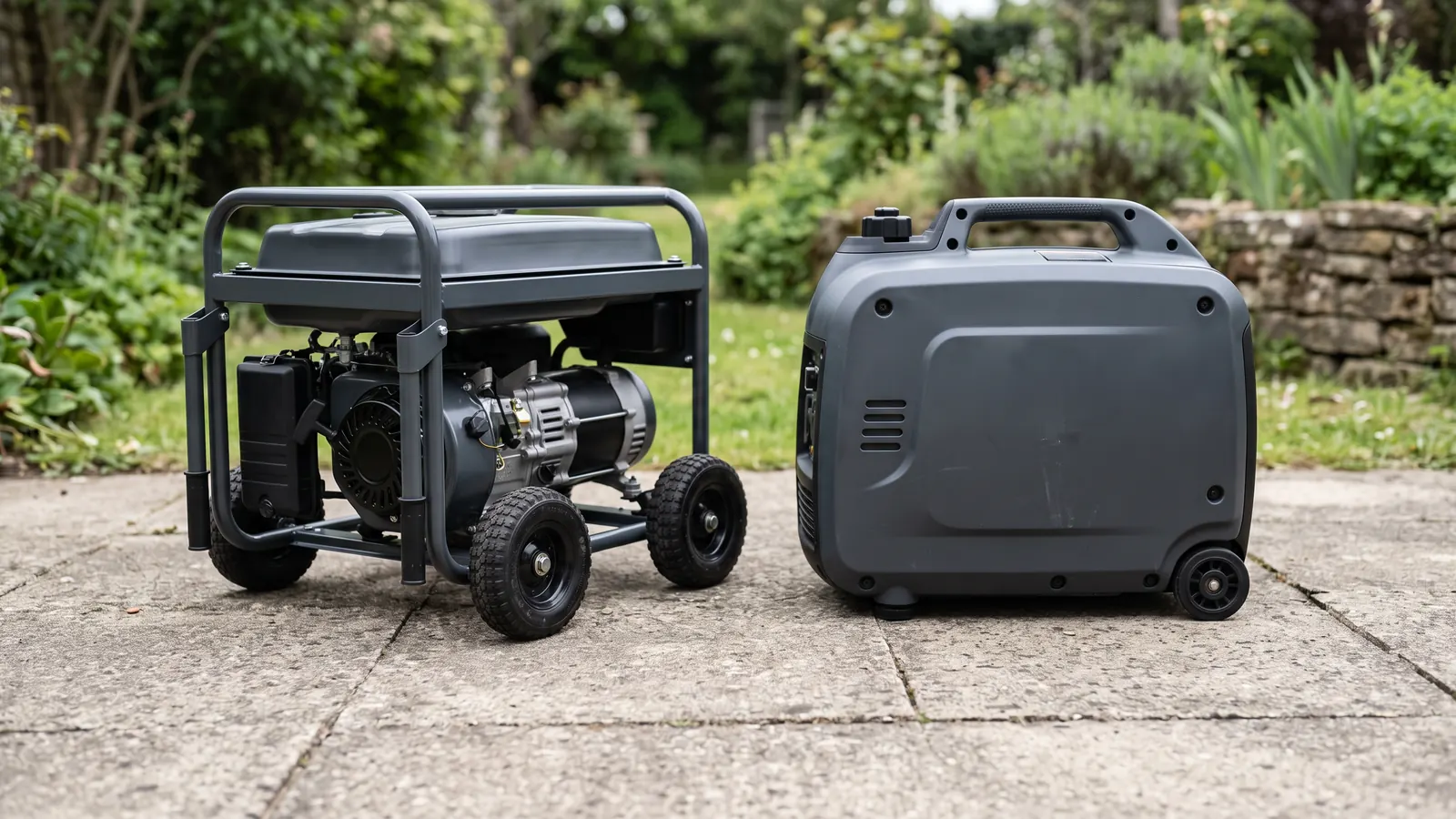
Short answer: For most homes, a 7,500 running watt dual-fuel generator with a 120/240 V L14-30R outlet and a CO shut-off, like the Westinghouse WGen7500DFc, covers the essentials plus a well pump, a window AC or a 2 to 3 ton central AC. For more at once, step up to the WGen9500DFc or DuroMax XP13000EH, which add a 50 amp 14-50R outlet. If you only need the fridge, lights and Wi-Fi, a 4,000 W inverter is quieter and lighter.
The "best" home backup generator is the smallest one that runs what you can't do without. Buy too small and the well pump won't start. Buy too big and you're feeding a 13,000 W engine to keep a fridge cold.
So this guide picks by job. Every model here lists a carbon monoxide (CO) shut-off on the maker's own page. We don't list gas generators without one. The figures come from makers' spec pages, linked at the end. We don't test units ourselves.
Quick picks
- Best fit for most homes: Westinghouse WGen7500DFc. 7,500 running and 9,500 peak watts on gas, dual fuel, a 120/240 V L14-30R outlet for a transfer switch or interlock. Runs the essentials plus a well pump, a window AC, or a 2 to 3 ton central AC.
- For a bigger house or more running at once: Westinghouse WGen9500DFc. 9,500 running and 12,500 peak watts on gas. It adds a 50 amp 14-50R outlet, so you're not capped at the L14-30's 7,200 W.
- The most watts here: DuroMax XP13000EH. 10,500 running and 13,000 peak watts on gas, 10,000 on propane, and the biggest tank (8.3 gal).
- Essentials only, quieter and lighter: Westinghouse iGen4000DFc. An inverter: 3,300 running and 4,000 peak watts, 62.8 lb. 120 V only, so no well pump or house hookup through a 240 V inlet.
Not sure what you need? Run the generator size calculator with your own appliances.
Side by side
| Model | Running / peak W (gas) | Running W on propane | 240 V outlets | Tank and run time (maker) |
|---|---|---|---|---|
| Westinghouse iGen4000DFc | 3,300 / 4,000 | 2,970 | None | 1.69 gal; 7 h at 25% |
| Westinghouse WGen7500DFc | 7,500 / 9,500 | 6,750 | L14-30R | 6.6 gal; 11 h at 25% |
| Westinghouse WGen9500DFc | 9,500 / 12,500 | 8,500 | L14-30R, 14-50R | 6.6 gal; 12 h at 25%, 8 h at 50% |
| DuroMax XP13000EH | 10,500 / 13,000 | 10,000 | L14-30R, 14-50R | 8.3 gal; 17 h at 25%, 8 h at 50% |
All four are dual fuel and list a CO shut-off. None claims CARB compliance on the pages we used, which matters if you live in California. See CARB-compliant generators.
Step 1: what do you need to run?
Size by appliances, not by square feet. From our whole-house sizing guide:
| What you'll run | About this many running watts | Pick |
|---|---|---|
| Fridge, sump pump, furnace fan, lights, Wi-Fi, TV | 3,000 (4,400 to start) | iGen4000DFc or bigger |
| Those plus a well pump or a window AC | 4,000 to 6,000 | WGen7500DFc |
| Those plus a 2 to 3 ton central AC | about 5,000 to 6,000, with 240 V | WGen7500DFc |
| Central air plus a well pump, or a bigger AC | 7,500 to 10,000, with 240 V | WGen9500DFc or XP13000EH |
Starting watts matter as much as running watts. A well pump, sump pump or AC compressor needs a burst of often 2 to 3 times its running watts for a few seconds to start. Add only the single biggest starting surge to your total. Start big motors one at a time.
Step 2: do you need 240 volts?
Many homes need 240 V for a deep well pump, central air, an electric water heater or a dryer. A 240 V outlet is also how you connect a portable generator to the house through a transfer switch or interlock kit.
- L14-30R: 30 amps at 120/240 V. That's a ceiling of 7,200 W (30 × 240), whatever size the generator is.
- 14-50R: 50 amps at 120/240 V, up to 12,000 W.
This is why the bigger picks matter for big loads. A 9,500 W generator feeding the house through an L14-30 cord can only deliver 7,200 W of it. To use more, the WGen9500DFc and XP13000EH have a 14-50R, and your inlet and transfer switch must be rated 50 amps. See 30 vs 50 amp generator cords.
The iGen4000DFc has no 240 V outlet. It's for running a few things on extension cords, not for feeding the panel.
Step 3: connect it the safe way
There are two safe ways to power your home's circuits from a portable generator: a transfer switch or an interlock kit. Either one must be installed by a licensed electrician, usually with a permit. Consumer Reports calls a transfer switch "infinitely more convenient than an extension cord".
Never plug a generator into a wall outlet (a "suicide cord"). It can send power back into the grid and injure or kill utility workers, and it can start a fire. See interlock vs transfer switch.
Gas or propane for a long outage
All four picks run on gasoline or propane. Propane gives a little less power (the WGen7500DFc drops from 7,500 to 6,750 running watts) but stores far better. Gasoline goes stale: WEN's manuals, for example, say to use gas within 30 days. Propane in a sealed tank doesn't go stale.
Run times, from the makers:
- WGen7500DFc: 11 hours at 25% load on 6.6 gallons of gas, or 8 hours at 25% on a 20 lb propane tank.
- WGen9500DFc: 8 hours at 50% load on gas, or 7 hours at 50% on a 20 lb tank.
- XP13000EH: 8 hours at 50% load on 8.3 gallons of gas. DuroMax lists a 40 lb tank as the minimum for propane.
For a multi-day outage, plan on several 20 lb tanks, or gas cans with stabilizer, and rotate them. Our propane tank runtime guide has the math.
Carbon monoxide: the deal-breaker
The CPSC warns about generator carbon monoxide deaths ahead of every storm season, and its advice is blunt: never run a generator inside a home, garage, basement, crawlspace or shed, even with doors and windows open. Run it outside, far from the house, with the exhaust pointed away from windows, doors and vents.
A CO shut-off stops the engine when CO builds up around it. Consumer Reports says it only recommends portable generators with one, and suggests looking for an "ANSI/UL 2201" or "ANSI/PGMA G300" certification mark on the box. Every pick here lists a CO shut-off. Still, put battery CO alarms on every level of your home. Read our generator carbon monoxide guide and how far a generator should be from the house.
What about a battery instead?
A big power station makes no fumes and no noise, so it can sit indoors. The EcoFlow DELTA Pro 3 lists 4,096 Wh, 4,000 W and a 120/240 V L14-30R outlet, so an electrician can connect it like a generator. But 4 kWh keeps a fridge, lights and Wi-Fi going for about a day or two, not a week, and it can't run central air for long. Many homes pair a battery for nights with a generator for long outages. See power station vs generator and check the DELTA Pro 3 on Amazon.
Which one should you buy?
- Fridge, lights, Wi-Fi and a sump pump, run on extension cords: Westinghouse iGen4000DFc.
- Most homes, with a well pump, window AC or 2 to 3 ton central AC, through a transfer switch: Westinghouse WGen7500DFc.
- A bigger house, or central air plus a well pump: Westinghouse WGen9500DFc.
- The most running watts on propane, and you can handle a 40 lb tank: DuroMax XP13000EH.
Check the WGen7500DFc on Amazon · Check the WGen9500DFc on Amazon · Check the XP13000EH on Amazon · Check the iGen4000DFc on Amazon
FAQ
What size portable generator do I need for a power outage?
For the basics (fridge, sump pump, furnace fan, lights), about 3,000 running and 4,400 starting watts. Add a well pump or window AC and it's 4,000 to 6,000 running watts. With central air, plan on a 7,500 to 10,000 W generator with 240 V. Use the size calculator for your home.
Can a portable generator run a whole house?
It can run most of a typical house, but not everything at once. Run the essentials, start big motors one at a time, and skip heat-making loads like an electric dryer or oven while the AC runs. See can a 7,500 watt generator run a house.
Is a 7,500 watt generator enough for central air?
For a 2 to 3 ton central AC plus the essentials, usually yes, with a 240 V hookup. Start the AC with nothing else big running, and consider a soft start. Through an L14-30 outlet it can send at most 7,200 W to the house. See can a 7,500 watt generator run a house and generators for central air.
Do I need a transfer switch?
To power your home's circuits, yes: a transfer switch or an interlock kit, installed by a licensed electrician. Without one, you can only run appliances plugged into the generator with outdoor-rated extension cords.
Is dual fuel worth it for home backup?
For most people, yes. Propane doesn't go stale in a sealed tank, so you have fuel ready when a storm hits. You give up about 10% of the power. See dual fuel vs gas.
What to look for
- A maker-stated carbon monoxide (CO) shut-off, ideally with an ANSI/UL 2201 or ANSI/PGMA G300 mark
- Running watts for everything you'll run at once, and starting watts for your biggest motor
- A 120/240 V outlet (L14-30R or 14-50R) if you'll connect to the house or run a well pump
- Dual fuel, so you can store propane instead of gasoline
- A run time at 25% or 50% load that gets you through a night
Models to consider
Westinghouse WGen7500DFc
Dual-fuel generator
- Power:
- 7,500 running / 9,500 starting W
- Fuel:
- Gas or propane (6,750 W on propane)
- CO shut-off:
- Yes
- CARB (California):
- No
Westinghouse WGen9500DFc
Dual-fuel generator
- Power:
- 9,500 running / 12,500 starting W
- Fuel:
- Gas or propane (8,500 W on propane)
- CO shut-off:
- Yes
- CARB (California):
- No
DuroMax XP13000EH
Dual-fuel generator
- Power:
- 10,500 running / 13,000 starting W
- Fuel:
- Gas or propane (10,000 W on propane)
- CO shut-off:
- Yes
- CARB (California):
- No
We don't test units ourselves; figures come from manufacturer spec sheets and the sources linked. How we research.
Sources
- Westinghouse WGen7500DFc spec page (7,500 running / 9,500 peak W on gas, 6,750 / 8,550 on propane, 6.6 gal, 11 h at 25%, 8 h at 25% on a 20 lb tank, L14-30R, CO sensor)
- Westinghouse WGen9500DFc spec page (9,500 running / 12,500 peak W on gas, 8,500 on propane, 6.6 gal, 12 h at 25% and 8 h at 50%, 7 h at 50% on a 20 lb tank, L14-30R and 14-50R, CO sensor)
- DuroMax XP13000EH product page (10,500 running / 13,000 peak W on gas, 10,000 on propane, 8.3 gal, 17 h at 25% and 8 h at 50%, 5-20R, L5-30R, L14-30R and 14-50R, CO sensor shutdown, 40 lb minimum propane tank)
- Westinghouse iGen4000DFc spec page (3,300 running / 4,000 peak W on gas, ≤3% THD, 62.8 lb, CO sensor)
- EcoFlow DELTA Pro 3 product page (4,096 Wh, 4,000 W / 8,000 W surge, 120/240 V, L14-30R)
- Consumer Reports: generator buying guide (only recommends portables with a CO safety shut-off; ANSI/UL 2201 and ANSI/PGMA G300 marks; transfer switch and interlock)
- CPSC: warning on generator carbon monoxide and fire hazards ahead of hurricane season (2026)
- WEN DF480iX manual, Apr 2026 (use gas within 30 days) (PDF)
- CPSC: Generators and engine-driven tools (carbon monoxide safety)
- Champion Power Equipment: generator wattage chart
- Wikipedia: NEMA connector (L14-30 and 14-50 ratings)