

Can a power station run a space heater? What size you need and how long it lasts
Updated 2026-10-31 · BestGenerator team
We may earn a commission if you buy through our links, at no extra cost to you. As an Amazon Associate I earn from qualifying purchases.
Short answer: A power station can run a 1,500 W space heater only if its continuous output is above 1,500 W, and even then it won't last long: a 1,070 Wh station gives about 36 minutes on high and a 2,048 Wh station about 70 minutes. A 4,096 Wh station gives about 2.3 hours. Heaters have no start-up surge, so continuous watts are what count. For a night of warmth, use the low setting, a heated blanket or a heater on a generator.
Picks for this page
Jackery Explorer 1000 v2
Power station (battery)
1,070 Wh · 1,500 W
Check price on AmazonEcoFlow DELTA 3 Max Plus
Power station (battery)
2,048 Wh · 3,000 W
Check price on AmazonEcoFlow DELTA Pro 3
Power station (battery)
4,096 Wh · 4,000 W
Check price on AmazonPower station runtime
Is it a fridge or freezer?
Add solar recharge (optional)
Estimated runtime
About 1.2 hours
2,048 Wh × 85% ÷ 1,500 W.
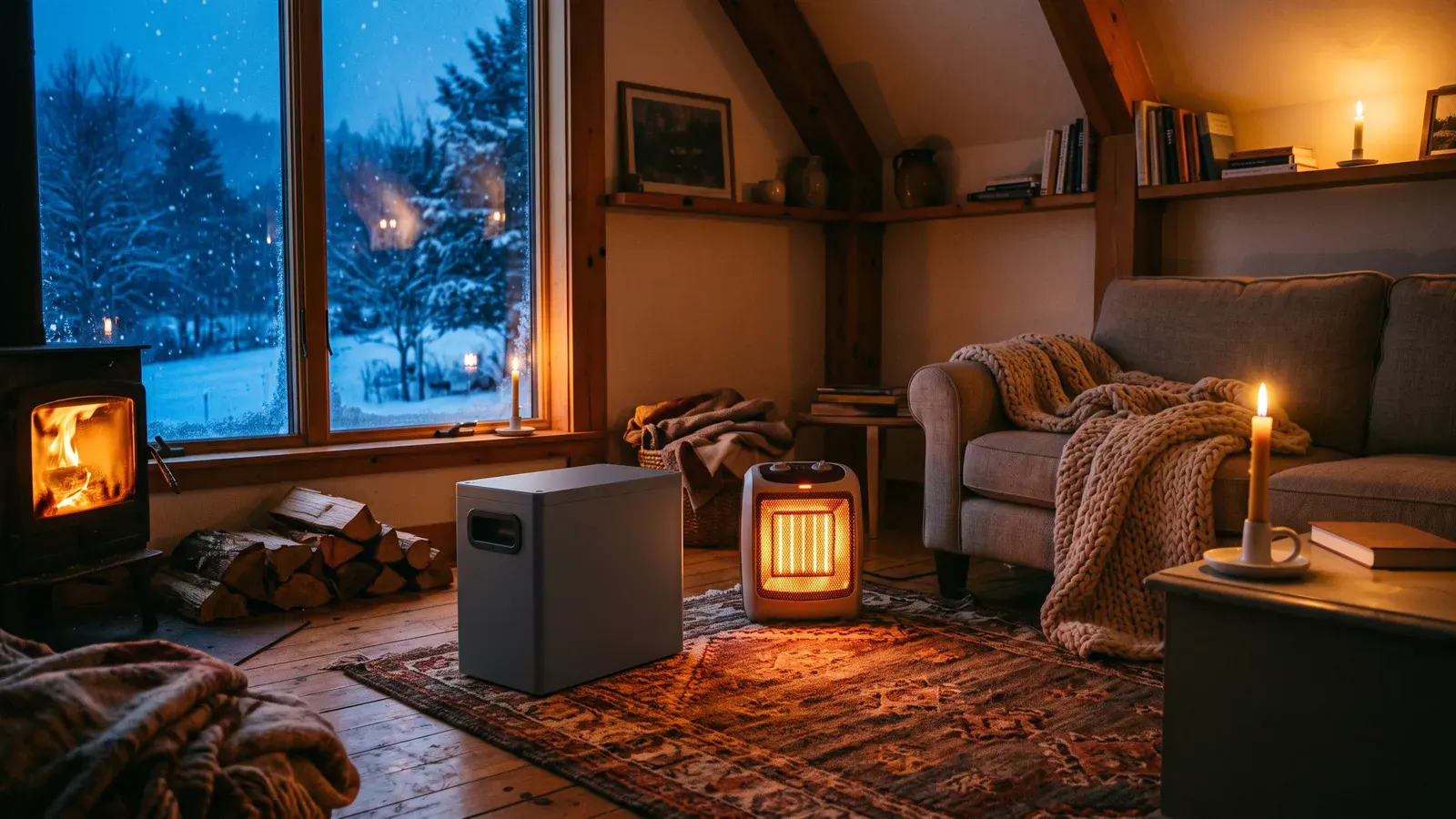
A space heater is the hardest common load for a battery. It's not a motor, so it has no start-up surge, but it pulls a big steady load for as long as it's on. That drains a power station in minutes to a couple of hours, not a night.
How many watts does a space heater use?
Champion lists space heaters at 750 to 1,500 W. Most plug-in heaters have a low setting near 750 W and a high setting at 1,500 W. Check the label on yours, usually "1500W" or "12.5A". There's no extra starting watts to plan for, so size by running watts only. (For the generator version of this question, see what size generator for a space heater.)
Which power stations can run a 1,500 W heater?
The station's continuous AC output must be above the heater's watts. Surge matters little here. From the makers' spec pages:
| Power station | Capacity | Continuous output | 1,500 W heater? |
|---|---|---|---|
| Jackery Explorer 1000 v2 | 1,070 Wh | 1,500 W | Right at the limit: use the low setting for margin |
| EcoFlow DELTA 3 Max Plus | 2,048 Wh | 3,000 W | Yes, with room to spare |
| EcoFlow DELTA Pro 3 | 4,096 Wh | 4,000 W | Yes, even two heaters |
A 500 W class station can't run a heater on high at all, and will shut off if you try. If one does, see power station shuts off under load.
How long will it run?
Hours = station Wh × 0.85 ÷ heater watts. The 0.85 allows for the energy lost turning battery power into 120 V AC.
| Station | Heater on high (1,500 W) | Heater on low (750 W) |
|---|---|---|
| 1,070 Wh | about 36 minutes | about 73 minutes |
| 2,048 Wh | about 70 minutes | about 2.3 hours |
| 4,096 Wh | about 2.3 hours | about 4.6 hours |
These are estimates, not measurements. Many heaters cycle their element on and off with a thermostat, so the real average may be lower. The calculator above starts at 1,500 W on a 2,048 Wh station; change the station and the watts to match your setup.
Heated blanket and low-watt heat
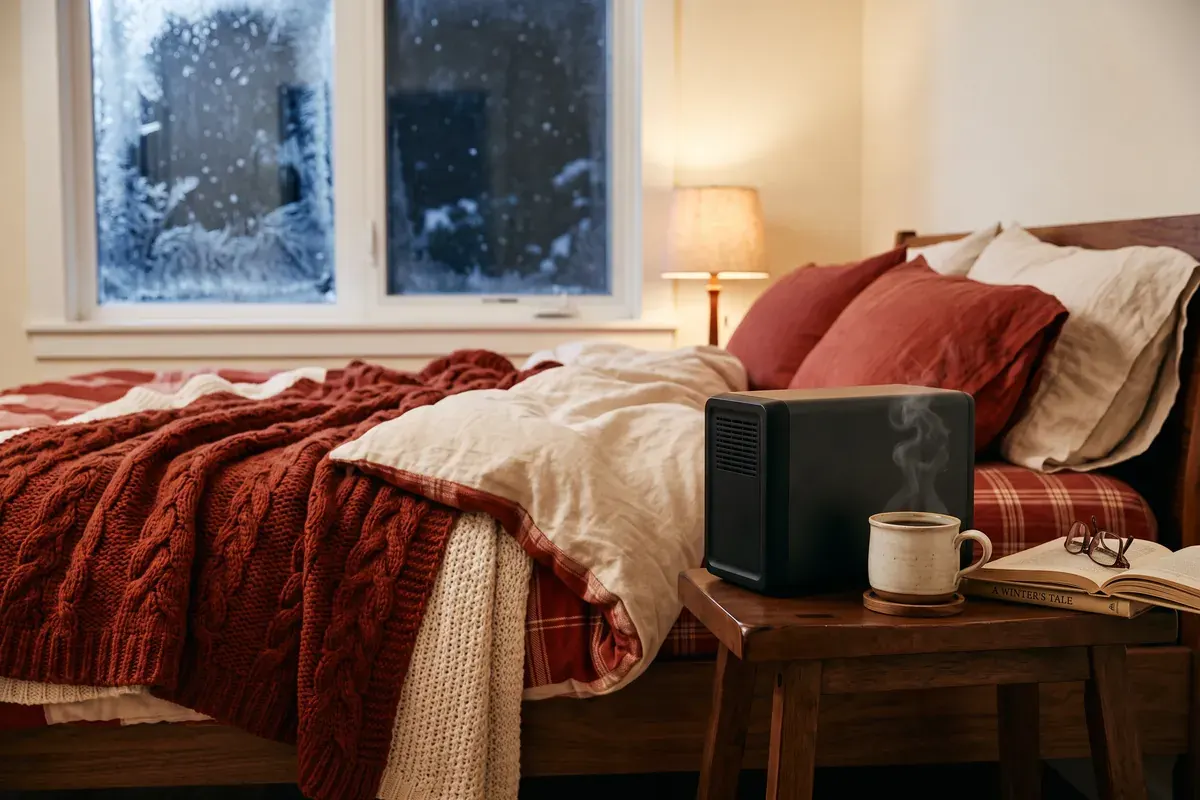
If you want to stay warm through a night, think small:
- Electric blankets and heating pads draw far less than a room heater. Read the watts on the label. As an example only, a 100 W blanket on a 1,070 Wh station runs about 1,070 × 0.85 ÷ 100 = 9 hours.
- Heat one small space. A closed bedroom with a blanket and bedding uses a fraction of the energy of heating a living room.
- Use low, or a thermostat. Half the watts doubles the run time.
That's why a modest station running a blanket often keeps people warmer overnight than a big one running a heater.
When a power station isn't enough
- Whole-house heat. A gas furnace needs power only for its blower and controls, far less than an electric heater. See what size generator for a gas furnace.
- Multi-day outages. Unless you can recharge, the station runs out. Plan around how long it takes to charge a power station.
- Several heaters. Add up the watts. Two on high is 3,000 W, which needs a 4,000 W class station.
For long outages, a fuel generator does better, run outdoors only. See the power stations for home backup guide for how stations fit the bigger picture.
Safety
- Plug the heater straight into the station or use a heavy-duty cord rated for the load. Don't chain power strips.
- Keep the heater clear of beds, curtains and paper, and follow its manual.
- Never run a generator indoors to charge the station. Outdoors only, 20+ feet from the house, away from windows and doors. Read our carbon monoxide guide.
What to look for
- Continuous AC watts above the heater's label (1,500 W for most plug-in heaters)
- Capacity in Wh: usable Wh divided by heater watts is your run time
- Pure sine wave AC output
- A way to recharge during a long outage (wall, car, solar or generator)
- A heater with a low setting or a thermostat, so the average draw is lower
Models to consider
Jackery Explorer 1000 v2
Power station (battery)
- Capacity:
- 1,070 Wh
- Inverter:
- 1,500 W (surge 3,000 W)
- Fuel:
- None — battery
- Battery:
- LiFePO4
- CARB (California):
- Not needed (no engine)
EcoFlow DELTA 3 Max Plus
Power station (battery)
- Capacity:
- 2,048 Wh
- Inverter:
- 3,000 W (surge 6,000 W)
- Fuel:
- None — battery
- Battery:
- LFP (LiFePO4)
- Noise:
- 25 dB (25 dB or less at 600 W load; distance not stated)
- CARB (California):
- Not needed (no engine)
EcoFlow DELTA Pro 3
Power station (battery)
- Capacity:
- 4,096 Wh
- Inverter:
- 4,000 W (surge 8,000 W)
- Fuel:
- None — battery
- Battery:
- LFP (LiFePO4)
- CARB (California):
- Not needed (no engine)
We don't test units ourselves; figures come from manufacturer spec sheets and the sources linked. How we research.