

Best inverter generator for camping and RVs: 4 picks with a CO shut-off
Updated 2026-10-08 · BestGenerator team
We may earn a commission if you buy through our links, at no extra cost to you. As an Amazon Associate I earn from qualifying purchases.
Short answer: For tent camping, a fridge and devices, a 2,500 W class inverter is enough: the WEN 56250iX (gas, 37.5 lb) or the Westinghouse iGen2550DFc (gas or propane, with an RV outlet). To start a 13,500 BTU RV air conditioner without a soft start, step up to the 4,000 W class: the Westinghouse iGen4000DFc or WEN DF480iX. All four list a carbon monoxide shut-off.
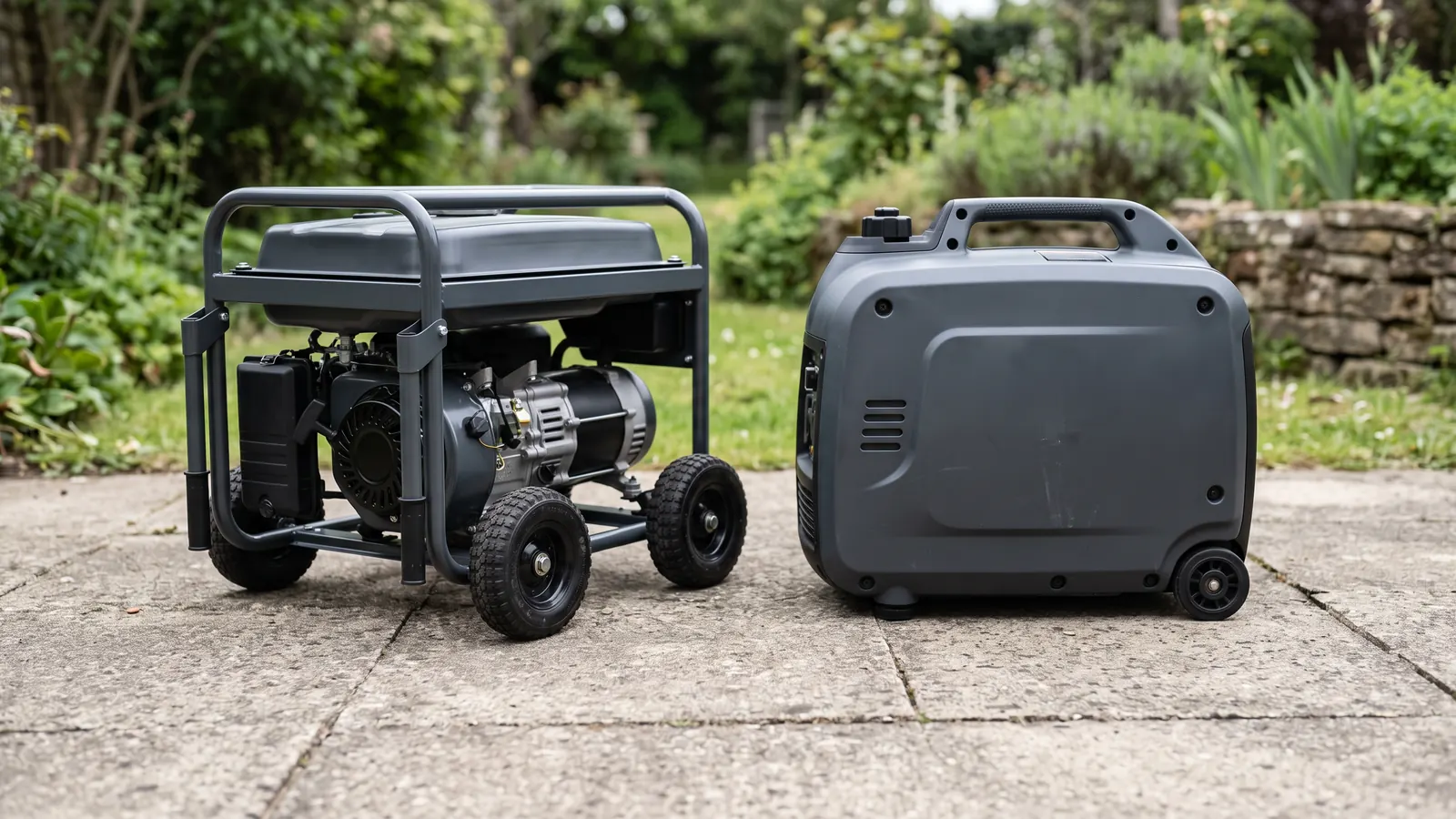
An inverter generator is the camping kind: smaller, lighter and quieter than an open-frame generator, with clean power for laptops and RV electronics. The question is which size. The answer mostly comes down to one appliance: does it need to start your RV's air conditioner?
Below are four picks in two sizes. All four list a carbon monoxide (CO) shut-off on the maker's own spec page. We don't list gas generators without one. Every figure is from the maker's spec page or manual, linked at the end. We don't test units ourselves.
Quick picks
2,500 W class: tent camping, a fridge, lights, fans, a TV and chargers
- Lightest, gas only: WEN 56250iX. 1,900 running and 2,500 starting watts, 37.5 lb. Two 120 V outlets, no RV outlet.
- Gas or propane, with an RV outlet: Westinghouse iGen2550DFc. 1,900 running and 2,550 peak watts on gas, a TT-30R for a 30 amp RV, 43.2 lb.
4,000 W class: a 30 amp RV with one 13,500 BTU AC
- Lighter, with remote start: Westinghouse iGen4000DFc. 3,300 running and 4,000 peak watts on gas, TT-30R, 62.8 lb.
- Most power and outlets: WEN DF480iX. 4,000 running and 4,800 peak watts on gas, TT-30R, four 120 V outlets and 12 V DC, 78.5 lb.
Side by side
| Model | Running / starting W (gas) | Propane running W | RV outlet (TT-30R) | Tank and run time (maker) | Weight |
|---|---|---|---|---|---|
| WEN 56250iX | 1,900 / 2,500 | Gas only | No | 1 gal; 4.8 h at half load | 37.5 lb |
| Westinghouse iGen2550DFc | 1,900 / 2,550 | 1,700 | Yes | 1.1 gal; 7 h at 50% load | 43.2 lb |
| Westinghouse iGen4000DFc | 3,300 / 4,000 | 2,970 | Yes | 1.69 gal; 7 h at 25% load | 62.8 lb |
| WEN DF480iX | 4,000 / 4,800 | 3,600 | Yes | 1.9 gal; 7 h at half load | 78.5 lb |
Run times were published at different loads (25% vs 50%), so they can't be compared head to head. All four can be paired with a second unit of the same make using that maker's parallel kit.
Will it start your RV air conditioner?
Champion's wattage chart lists a 13,500 BTU RV air conditioner at 1,500 to 2,000 running watts and 2,800 to 3,500 starting watts. The starting figure is the one that matters, and it's where most people get caught out.
- 2,500 W class: the AC can run on these, but it usually won't start, because 2,500 starting watts is below the AC's starting need. With a soft start fitted to the AC, a 2,000 to 2,500 W inverter often can start it, as long as little else is on. Micro-Air, which makes one, says so on its product page. See a 2,000 W generator and a 13,500 BTU AC.
- 4,000 W class: 4,000 to 4,800 starting watts covers the AC's starting range, with room for the fridge and lights.
Not sure? The RV AC check does the math for your AC and generator.
A 30 amp RV draws 3,600 W at most (30 A × 120 V). That's a ceiling, not a size you must buy. See what size generator for a 30 amp RV. A 50 amp RV with two ACs needs more than any single unit here. One option is two parallel units. WEN's 30 A parallel kit is rated 3,600 W, and its larger kits go higher. See parallel inverter generators.
Noise: what the dB figures do and don't tell you
Every maker lists a noise figure, but they measure differently. WEN lists 65 dBA (56250iX) and 62 dB (DF480iX), both at 25% load. Westinghouse lists 52 dBA for both its models, without saying at what distance or load. Figures measured under different conditions can't be ranked against each other. Don't pick on the dB number alone.
What matters at a campground:
- National parks: motorized equipment such as generators can't go over 60 dBA measured at 50 feet (36 CFR 2.12). A maker figure without a stated distance doesn't tell you whether a unit meets that.
- Generator hours: many campgrounds allow generators only at set times, and some loops ban them. Check before you book.
- Placement: point the exhaust away from your rig and your neighbors, and keep it at a distance. Distance cuts noise and keeps fumes away.
Gas or propane?
Three of the four are dual fuel. Propane stores well: it stays sealed in its tank and doesn't go stale like gasoline. RVs often already carry propane. The trade-off is less power. Westinghouse rates the iGen4000DFc at 3,300 running watts on gas but 2,970 on propane, about 10% less. If your AC start is close to the limit, test it on propane before a trip. More in dual fuel vs gas.
On a 20 lb propane tank, WEN lists the DF480iX at 12 hours at half load. Westinghouse lists the iGen2550DFc at 20 hours at 50% load.
Camping up high
Generators lose power with altitude. Westinghouse's manual says output drops about 3.5% per 1,000 feet above sea level. At 5,000 feet, a 4,000 W generator acts more like 3,300 W, which can be the difference between the AC starting or not. WEN's manual warns that some altitudes call for a high-altitude kit. Read yours before a mountain trip.
Carbon monoxide: the feature that matters most
Gas generators make carbon monoxide, and you can't see or smell it. Consumer Reports only recommends portable generators with a CO safety shut-off, which stops the engine when CO builds up. All four picks list one: WEN calls it Watchdog, Westinghouse calls it a CO sensor. Consumer Reports also suggests looking for an "ANSI/UL 2201" or "ANSI/PGMA G300" certification mark on the box or listing.
A shut-off is a backup, not permission. Never run a generator inside an RV, a tent, a camper shell, a garage or under an awning. Keep the exhaust pointed away from open windows and vents, and have a working CO alarm inside the RV. Read our generator carbon monoxide guide.
Which one should you buy?
- Tent or van camping, light loads, you carry it yourself: WEN 56250iX.
- A small trailer, a 30 amp plug and propane on board, no AC or an AC with a soft start: Westinghouse iGen2550DFc.
- A 30 amp RV with one 13,500 BTU AC, and you want it lighter: Westinghouse iGen4000DFc.
- The most watts and outlets in this group, and you can handle 78.5 lb: WEN DF480iX.
California campers: none of the makers' pages we used claim CARB compliance for these models. See CARB-compliant generators.
Check the WEN 56250iX on Amazon · Check the iGen2550DFc on Amazon · Check the iGen4000DFc on Amazon · Check the DF480iX on Amazon
FAQ
What size inverter generator do I need for camping?
For a fridge, lights, fans and chargers, about 2,000 to 2,500 W is plenty. For a 13,500 BTU RV air conditioner, you need about 2,800 to 3,500 starting watts, so a 4,000 W class unit, or a smaller one with a soft start on the AC.
Can a 2,500 watt inverter generator run an RV air conditioner?
It can usually run one but often can't start one. With a soft start kit on the AC, many 2,000 to 2,500 W inverters can start a 13,500 BTU unit if little else is on. Check with the RV AC check.
Is an inverter generator safe for laptops and RV electronics?
Inverter generators make cleaner power than open-frame ones. Westinghouse lists ≤3% THD for its iGen models, a common bar for sensitive electronics. WEN calls its power "clean" but doesn't list a number. See what THD means.
Should I get a power station instead?
For tent camping with phones, lights and a 12 V fridge, a power station is quieter and simpler. For an RV air conditioner, a generator is still the practical choice. See the best power station for camping.
How far should the generator be from my RV or tent?
As far as your cord and campground allow, with the exhaust pointed away from you and your neighbors. Never run it under an awning or in an enclosed space. See how far a generator should be from a house for the same logic.
What to look for
- A maker-stated carbon monoxide (CO) shut-off
- Enough starting watts for your RV AC: about 2,800 to 3,500 W for a 13,500 BTU unit
- A TT-30R outlet if you'll plug a 30 amp RV straight in
- Dual fuel if you'd rather carry propane than gasoline
- A weight you can lift into the truck or onto the bumper
- Parallel capability if you might add a second unit later
Models to consider
Westinghouse iGen2550DFc
Dual-fuel generator
- Power:
- 1,900 running / 2,550 starting W
- Fuel:
- Gas or propane (1,700 W on propane)
- CO shut-off:
- Yes
- CARB (California):
- No
WEN 56250iX
Inverter generator
- Power:
- 1,900 running / 2,500 starting W
- Fuel:
- Gasoline
- CO shut-off:
- Yes
- Noise:
- 65 dB (at 25% load; distance not stated)
- CARB (California):
- No
Westinghouse iGen4000DFc
Dual-fuel generator
- Power:
- 3,300 running / 4,000 starting W
- Fuel:
- Gas or propane (2,970 W on propane)
- CO shut-off:
- Yes
- CARB (California):
- No
We don't test units ourselves; figures come from manufacturer spec sheets and the sources linked. How we research.
Sources
- Westinghouse iGen2550DFc spec page (1,900 running / 2,550 peak W on gas, 1,700 W on propane, 1.1 gal, 11 h at 25% and 7 h at 50% on gas, TT-30R, ≤3% THD, parallel, CO sensor, 43.2 lb)
- WEN 56250iX product page (1,900 rated / 2,500 surge W, Watchdog CO shutdown sensor, 37.5 lb)
- WEN 56250iX manual, Aug 2026 (65 dBA at 25% load, 1 gal tank, 4.8 h at half load, parallel operation, high-altitude kit warning) (PDF)
- Westinghouse iGen4000DFc spec page (3,300 running / 4,000 peak W on gas, 2,970 / 3,600 on propane, 1.69 gal, 7 h at 25%, TT-30R, remote start, parallel, CO sensor, 62.8 lb)
- WEN DF480iX product page (4,000 running / 4,800 peak W, 3,600 W on propane, TT-30R, 12 V DC, Watchdog CO shutdown sensor, 62 dB at quarter load)
- WEN DF480iX manual, Apr 2026 (1.9 gal, 7 h at half load on gas, 12 h at half load on a 20 lb tank, 78.5 lb, parallel) (PDF)
- Champion Power Equipment: generator wattage chart (13,500 BTU RV AC: 1,500–2,000 running, 2,800–3,500 starting W)
- Micro-Air: RV AC soft starter (maker's claims and customer reports)
- Westinghouse WGen9500DF manual: high-altitude derate, about 3.5% per 1,000 feet (PDF)
- 36 CFR 2.12, National Park Service audio disturbance rule (motorized equipment such as generators over 60 dBA at 50 feet)
- Consumer Reports: generator buying guide (CO safety shut-off; ANSI/UL 2201 and ANSI/PGMA G300 marks)
- WEN: 30 A 3,600 W parallel kit for inverter generators