

Best generator for a 50 amp RV: 3 picks that run two ACs, with a CO shut-off
Updated 2026-11-23 · BestGenerator team
We may earn a commission if you buy through our links, at no extra cost to you. As an Amazon Associate I earn from qualifying purchases.
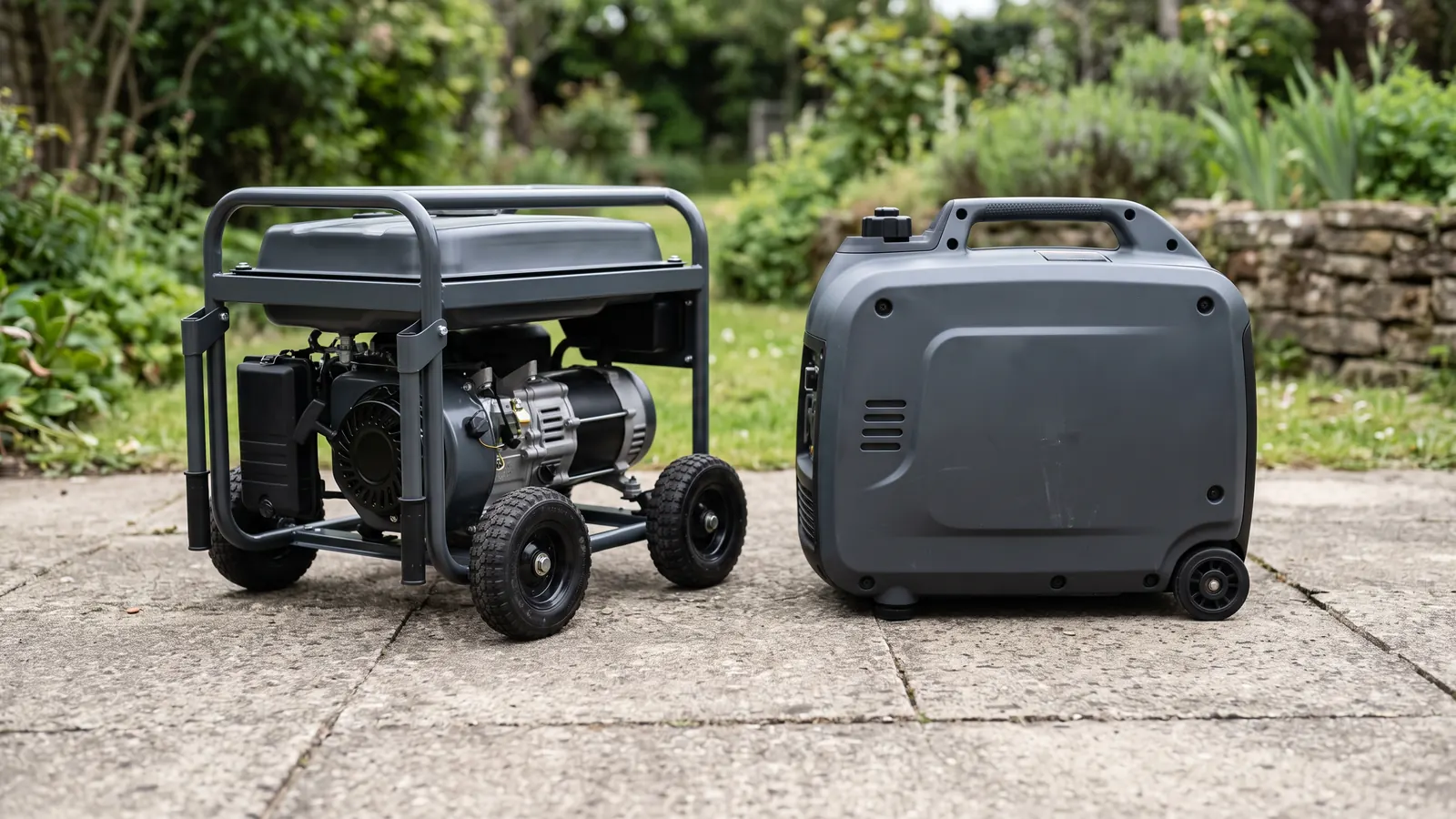
Short answer: Two 13,500 BTU ACs plus a fridge, microwave, lights and TV need about 5,700 running and 7,500 starting watts with headroom. The Westinghouse WGen9500DFc is the best fit for most 50 amp RVs: 9,500 running watts on gas and a 120/240 V 14-50R outlet your RV cord plugs straight into. The DuroMax XP13000EH has more watts (10,500) and the biggest tank. The Westinghouse WGen7500DFc works through an L14-30 to 14-50 adapter, which caps it at 7,200 W, still enough for two ACs and the basics. All three are loud open-frame generators, so check campground rules.
A 50 amp RV often means two roof air conditioners plus a fridge and a microwave, and that's more than any single inverter generator on our list can start. You need a big generator with the right outlet, or two smaller ones working together.
This guide picks three generators that can run two ACs and the basics, and explains the quieter parallel option. Every pick lists a carbon monoxide (CO) shut-off on the maker's own page; we don't list gas generators without one. We don't test units ourselves. Figures are from makers' spec pages and manuals, linked at the end.
Quick picks
- Best fit for most 50 amp RVs: Westinghouse WGen9500DFc. 9,500 running and 12,500 peak watts on gas (8,500 on propane), with a 120/240 V 14-50R your 50 amp cord plugs into. Dual fuel.
- The most watts and the biggest tank: DuroMax XP13000EH. 10,500 running and 13,000 peak watts on gas, 10,000 on propane, 14-50R, 8.3 gal tank. Needs at least a 40 lb propane tank, per DuroMax.
- Enough for two ACs, through an adapter: Westinghouse WGen7500DFc. 7,500 running and 9,500 peak watts on gas. It has an L14-30R, not a 14-50R, so with an L14-30 to 14-50 adapter it can deliver up to 7,200 W.
Check your own RV's load with the generator size calculator (add two RV ACs, fridge, microwave, lights and TV).
Side by side
| Model | Running / peak W, gas (propane running) | RV hookup | Most it can send your RV | Tank and run time (maker) |
|---|---|---|---|---|
| Westinghouse WGen9500DFc | 9,500 / 12,500 (8,500) | 14-50R | 9,500 W running | 6.6 gal; 12 h at 25%, 8 h at 50% |
| DuroMax XP13000EH | 10,500 / 13,000 (10,000) | 14-50R | 10,500 W running | 8.3 gal; 17 h at 25%, 8 h at 50% |
| Westinghouse WGen7500DFc | 7,500 / 9,500 (6,750) | L14-30R + adapter | 7,200 W (30 A × 240 V) | 6.6 gal; 11 h at 25% |
A 14-50 outlet is rated 50 A at 120/240 V, up to 12,000 W, so the generator's own output is the limit. All three list a CO shut-off. None claims CARB compliance on the maker pages we used, which matters if you camp in California: see CARB-compliant generators.
How much generator does a 50 amp RV need?
The 50 amp label is a ceiling (two 120 V legs of 50 A, 12,000 W), not what you'll use. From our 50 amp RV sizing guide, using Champion's chart figures:
| What's on | Running W | Starting W | With 20% headroom | Picks that cover it |
|---|---|---|---|---|
| 1 AC (13,500 BTU) + fridge, microwave, lights, TV, chargers | 3,230 | 4,730 | about 3,900 / 5,700 | All three |
| 2 ACs (13,500 BTU) + the same | 4,730 | 6,230 | about 5,700 / 7,500 | All three |
| 2 ACs (15,000 BTU) + the same | 5,730 | 7,230 | about 6,900 / 8,700 | WGen9500DFc, XP13000EH |
| 3 ACs (13,500 BTU) + the same | 6,230 | 7,730 | about 7,500 / 9,300 | WGen9500DFc, XP13000EH |
Start the ACs one at a time: turn one on, wait a minute, then the other. Then only one AC's starting surge counts. Champion also lists an RV electric water heater at 1,200 to 1,500 W; add it if you'll run it on the generator.
Who each one is for
Most 50 amp rigs: Westinghouse WGen9500DFc
The 14-50R matches your RV's cord, so there's no adapter and no 7,200 W cap. 9,500 running watts covers two 15,000 BTU ACs and the basics with room to spare, and still 8,500 on propane. Westinghouse lists 7 hours at 50% load on a 20 lb propane tank, or 8 hours at 50% on its 6.6 gallon gas tank.
Big rigs and long days: DuroMax XP13000EH
The most running watts here, and nearly as much on propane (10,000). The 8.3 gallon tank gives the longest published gas run time, 17 hours at 25% load. The trade-offs: it needs at least a 40 lb propane tank, and it's a large generator to haul and store.
Two ACs on a budget of watts: Westinghouse WGen7500DFc
Through an L14-30 to 14-50 adapter, it can deliver up to 7,200 W. That covers two 13,500 BTU ACs and the basics (about 5,700 running watts with headroom). It's the tightest of the three for three ACs or 15,000 BTU units. An adapter doesn't add power; it just lets the plugs fit. See 30 vs 50 amp cords.
The quiet option: two inverters in parallel
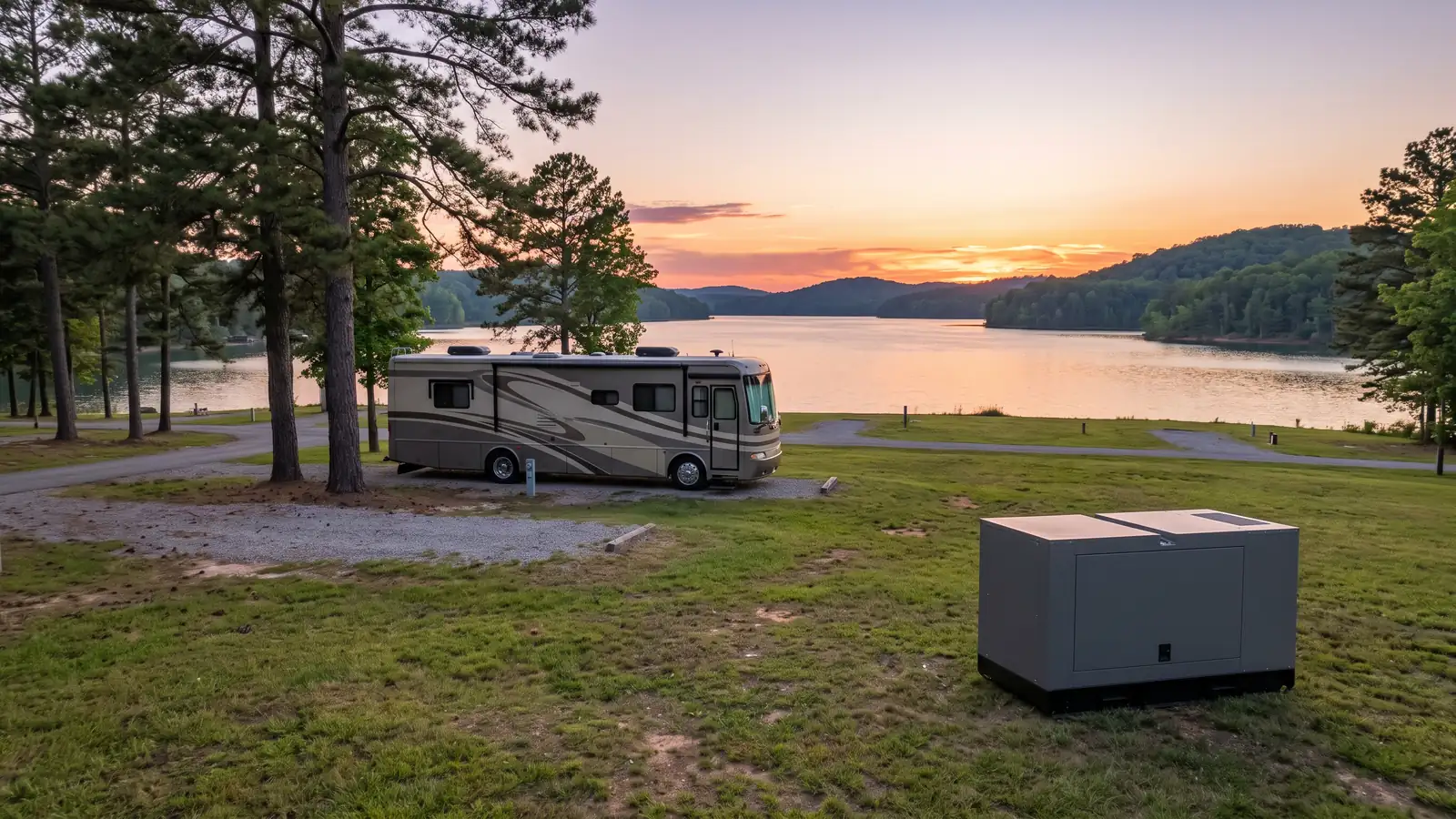
All three picks are open-frame generators listed at 72 to 74 dB(A), without a stated distance or load. That's fine for boondocking or a storm at home, but it can break campground quiet rules. In U.S. national parks, generators can't go over 60 dBA at 50 feet (36 CFR 2.12).
The quieter route is two inverter generators linked with a parallel kit. Westinghouse lists the iGen4000DFc as parallel capable, and WEN's manual covers parallel use of the DF480iX. The kit sets the ceiling:
- A 30 A kit (TT-30R and L5-30R, 120 V; WEN's GNA36i is rated 3,600 W) feeds a 50 amp RV only 3,600 W through an adapter: one AC and the basics.
- A 50 A 120 V kit with a 14-50R (WEN's GNA50i is rated 6,000 W) has room for two 13,500 BTU ACs running (about 3,000 W). With the fridge, microwave and the rest on, the starting surge (about 6,230 W on our sizing table) is just over that limit, so start the ACs one at a time, keep the microwave off while they start, and consider soft starts. It's 120 V only, so 240 V RV appliances won't run.
Check that the kit is approved for your exact generator models before you buy. More in parallel inverter generators, and see the quiet generator guide for what the dB figures mean.
Does your RV need 240 V?
A 50 amp RV splits its 120 V loads across two legs. Some big RVs also have 240 V appliances, and those need a true 120/240 V source. The 14-50R on the WGen9500DFc and XP13000EH is 120/240 V, as is the WGen7500DFc's L14-30R. A 120 V-only parallel kit feeds the same 120 V to both legs, so check your RV's manual first.
Camping up high
Generators make less power with altitude. Westinghouse's manual says output drops about 3.5% for each 1,000 feet above sea level. At 5,000 feet, the WGen7500DFc's 7,500 running watts becomes about 6,200 W, and through an adapter the 7,200 W cap is moot. Two ACs still fit, with less room. The bigger picks keep more headroom.
Other ways to power a 50 amp RV
- A soft start on each AC cuts the starting surge, so a smaller generator or parallel pair can start them. See a 2,000 W generator and a 13,500 BTU AC.
- A big battery? The Jackery Explorer 5000 Plus lists 5,040 Wh, 7,200 W and 120/240 V, but two ACs drawing about 3,000 W would drain it in about 5,040 × 0.85 ÷ 3,000 = 1.4 hours. It's for quiet hours, not all-day AC. See the best portable power stations.
- Hooking up: see how to connect a generator to an RV. A 50 amp cord needs heavy 6-gauge wire.
Carbon monoxide: the rule that matters most
Never run a generator inside or under the RV, in a garage, or under an awning. Place it far from your rig and your neighbors', with the exhaust pointed away from windows, doors, vents and slide-outs. Consumer Reports only recommends portables with a CO safety shut-off and suggests looking for an "ANSI/UL 2201" or "ANSI/PGMA G300" mark. All three picks list a CO shut-off. Keep a working CO alarm inside the RV, and test it before each trip. Read the generator carbon monoxide guide.
Which one should you buy?
- Most 50 amp RVs, two ACs and a plug-straight-in 14-50R: Westinghouse WGen9500DFc.
- Three ACs, 15,000 BTU units or long run times: DuroMax XP13000EH.
- Two 13,500 BTU ACs, and you're fine with an adapter and a 7,200 W cap: Westinghouse WGen7500DFc.
- Campgrounds with quiet rules: two parallel inverters with a 50 A kit approved for them.
Check the WGen9500DFc on Amazon · Check the XP13000EH on Amazon · Check the WGen7500DFc on Amazon
FAQ
What size generator do I need for a 50 amp RV with two ACs?
About 5,700 running and 7,500 starting watts with 20% headroom, for two 13,500 BTU ACs plus a fridge, microwave, lights and TV, starting the ACs one at a time. See what size generator for a 50 amp RV.
Can I plug a 50 amp RV into a 30 amp generator outlet?
With an adapter, yes, but you get only what that outlet carries: 3,600 W from a TT-30R (one AC and a few small things) or 7,200 W from an L14-30R (two ACs and the basics).
Do I need a 12,000 watt generator for a 50 amp RV?
No. 12,000 W is the most a 50 amp service can carry, not what your RV uses. Most two-AC rigs are fine with 7,500 to 9,500 running watts.
Can one inverter generator run a 50 amp RV?
Not with two ACs on: the biggest single inverters here have 4,000 to 4,800 starting watts. One inverter can run one AC and the basics through a 50-to-30 adapter. For two ACs, pair two with a 50 A parallel kit approved for them.
Is a dual fuel generator good for RVing?
Yes, if you already carry propane. You give up about 10% of the power on the Westinghouse models (about 5% on the DuroMax), per the makers. See the best dual fuel generators.
What to look for
- A 14-50R outlet (120/240 V) for the full 50 amp hookup, or an L14-30R plus an adapter (7,200 W cap)
- About 5,700 running and 7,500 starting watts for two 13,500 BTU ACs and the basics
- A maker-stated carbon monoxide (CO) shut-off
- True 120/240 V output if your RV has 240 V appliances
- Campground generator rules: open-frame units are loud
Models to consider
Westinghouse WGen9500DFc
Dual-fuel generator
- Power:
- 9,500 running / 12,500 starting W
- Fuel:
- Gas or propane (8,500 W on propane)
- CO shut-off:
- Yes
- CARB (California):
- No

Amazon.com price: $1,049.00
as of Nov 27, 6:18 PM EST · Details
Product prices and availability are accurate as of the date/time indicated and are subject to change. Any price and availability information displayed on Amazon.com at the time of purchase will apply to the purchase of this product.
DuroMax XP13000EH
Dual-fuel generator
- Power:
- 10,500 running / 13,000 starting W
- Fuel:
- Gas or propane (10,000 W on propane)
- CO shut-off:
- Yes
- CARB (California):
- No

Amazon.com price: $1,299.00
as of Nov 27, 6:12 PM EST · Details
Product prices and availability are accurate as of the date/time indicated and are subject to change. Any price and availability information displayed on Amazon.com at the time of purchase will apply to the purchase of this product.
Westinghouse WGen7500DFc
Dual-fuel generator
- Power:
- 7,500 running / 9,500 starting W
- Fuel:
- Gas or propane (6,750 W on propane)
- CO shut-off:
- Yes
- CARB (California):
- No

Amazon.com price: $949.00
as of Nov 27, 6:12 PM EST · Details
Product prices and availability are accurate as of the date/time indicated and are subject to change. Any price and availability information displayed on Amazon.com at the time of purchase will apply to the purchase of this product.
We don't test units ourselves; figures come from manufacturer spec sheets and the sources linked. How we research.
Sources
- Westinghouse WGen9500DFc spec page (9,500 running / 12,500 peak W on gas, 8,500 on propane, 6.6 gal, 12 h at 25% and 8 h at 50%, 7 h at 50% on a 20 lb tank, L14-30R and 14-50R, 74 dBA, CO sensor)
- DuroMax XP13000EH product page (10,500 running / 13,000 peak W on gas, 10,000 on propane, 8.3 gal, 17 h at 25% and 8 h at 50%, L14-30R and 14-50R, 74 dB, CO sensor shutdown, 40 lb minimum propane tank)
- Westinghouse WGen7500DFc spec page (7,500 running / 9,500 peak W on gas, 6,750 on propane, 6.6 gal, 11 h at 25%, L14-30R, 72 dBA, CO sensor)
- WEN: L14-30P to 14-50R adapter, rated 30 A, 240 V, 7,200 W
- WEN: GNA50i 50 A 6,000 W parallel kit (14-50R at 120 V, L5-30R)
- WEN: GNA36i 30 A 3,600 W parallel kit (TT-30R and L5-30R)
- Westinghouse iGen4000DFc spec page (3,300 running / 4,000 peak W, TT-30R, parallel capable, CO sensor)
- WEN DF480iX manual, Apr 2026 (4,000 running W on gas, 3,600 on propane, parallel operation, 78.5 lb) (PDF)
- Jackery Explorer 5000 Plus product page (5,040 Wh, 7,200 W / 14,400 W surge, 120/240 V, 134.5 lb)
- Champion Power Equipment: generator wattage chart (13,500 BTU RV AC 1,500–2,000 running, 2,800–3,500 starting W; RV fridge, microwave, water heater)
- Westinghouse WGen9500DF manual: high-altitude derate, about 3.5% per 1,000 feet (PDF)
- 36 CFR 2.12, National Park Service audio disturbance rule (generators over 60 dBA at 50 feet)
- Wikipedia: NEMA connector (14-50: 50 A, 125/250 V; L14-30: 30 A, 125/250 V)
- Consumer Reports: generator buying guide (CO safety shut-off; ANSI/UL 2201 and ANSI/PGMA G300 marks)