

Best portable generator 2026: picks for home backup, camping and big houses
Updated 2026-11-23 · BestGenerator team
We may earn a commission if you buy through our links, at no extra cost to you. As an Amazon Associate I earn from qualifying purchases.
Short answer: For most homes, a 7,500 running watt dual-fuel generator with a 120/240 V L14-30R outlet and a CO shut-off, like the Westinghouse WGen7500DFc, is the best all-round portable. For camping or a 30 amp RV with one AC, a 4,000 W inverter like the Westinghouse iGen4000DFc is quieter and lighter. If you only need a fridge, lights and chargers, the WEN 56250iX is the smallest and simplest pick. For a big house with central air and a well pump, step up to the WGen9500DFc or DuroMax XP13000EH.
There is no single best portable generator. There is a best one for the job you have: keeping a house going through a storm, running an RV's air conditioner, or keeping a fridge cold on a budget. Buy for the wrong job and you get a generator that can't start your well pump, or one that's far too loud and heavy for a campsite.
So this guide picks by use. Every model here is one we've checked on the maker's own page, and every one lists a carbon monoxide (CO) shut-off. We don't list gas generators without one. We don't test units ourselves; the figures are from makers' spec pages and manuals, linked at the end.
Quick picks
- Best for most homes: Westinghouse WGen7500DFc. 7,500 running and 9,500 peak watts on gas, dual fuel, and a 120/240 V L14-30R outlet for a transfer switch or interlock. Runs the essentials plus a well pump, a window AC or a 2 to 3 ton central AC.
- Best for camping and a 30 amp RV: Westinghouse iGen4000DFc. An inverter: 3,300 running and 4,000 peak watts, a TT-30R RV outlet, dual fuel, 62.8 lb. Enough to start one 13,500 BTU RV air conditioner.
- Smallest and simplest: WEN 56250iX. A gas-only inverter: 1,900 running and 2,500 starting watts, 37.5 lb. A fridge, lights, a TV and chargers, and not much more.
- Best for a big house: DuroMax XP13000EH. 10,500 running and 13,000 peak watts on gas, 10,000 on propane, and a 50 amp 14-50R outlet. The Westinghouse WGen9500DFc (9,500 running, also with a 14-50R) is the step between.
Not sure how many watts you need? The generator size calculator works it out from the appliances you pick.
All seven, side by side
| Model | Type | Running / starting W (gas) | Running W on propane | 240 V outlet | Tank and run time (maker) |
|---|---|---|---|---|---|
| WEN 56250iX | Inverter, gas only | 1,900 / 2,500 | Gas only | None | 1 gal; 4.8 h at half load |
| Westinghouse iGen2550DFc | Inverter, dual fuel | 1,900 / 2,550 | 1,700 | None | 1.1 gal; 7 h at 50% |
| Westinghouse iGen4000DFc | Inverter, dual fuel | 3,300 / 4,000 | 2,970 | None | 1.69 gal; 7 h at 25% |
| WEN DF480iX | Inverter, dual fuel | 4,000 / 4,800 | 3,600 | None | 1.9 gal; 7 h at half load |
| Westinghouse WGen7500DFc | Open frame, dual fuel | 7,500 / 9,500 | 6,750 | L14-30R | 6.6 gal; 11 h at 25% |
| Westinghouse WGen9500DFc | Open frame, dual fuel | 9,500 / 12,500 | 8,500 | L14-30R, 14-50R | 6.6 gal; 8 h at 50% |
| DuroMax XP13000EH | Open frame, dual fuel | 10,500 / 13,000 | 10,000 | L14-30R, 14-50R | 8.3 gal; 8 h at 50% |
Run times are published at different loads (25% or 50%), so they can't be compared line by line. All seven list a CO shut-off. None claims CARB compliance on the maker pages we used, which matters in California: see CARB-compliant generators.
Who each one is for
Home backup for most houses: Westinghouse WGen7500DFc
This is the size most homes end up at. Our whole-house sizing guide puts the essentials (fridge, sump pump, furnace fan, lights, Wi-Fi) at about 3,000 running watts. Add a well pump or a window AC and it's 4,000 to 6,000. The WGen7500DFc's 7,500 running watts covers that with room to start a motor, and its L14-30R is the outlet a transfer switch or interlock inlet expects. One limit to know: an L14-30 connection carries at most 7,200 W (30 A × 240 V), whatever the generator's size. More in the home backup buying guide.
Camping and a 30 amp RV: Westinghouse iGen4000DFc
Champion's wattage chart lists a 13,500 BTU RV air conditioner at 2,800 to 3,500 starting watts. The iGen4000DFc's 4,000 peak watts covers that, and it has the TT-30R your RV plugs into. It's an inverter, so it's quieter than an open-frame generator and makes cleaner power: Westinghouse lists ≤3% THD. If you need more outlets and watts and can handle 78.5 lb, the WEN DF480iX is the alternative. See the inverter generator guide for camping and RVs.
A tight budget or light loads: WEN 56250iX
The 2,500 W class is the simplest way in. The WEN 56250iX runs a fridge, lights, a TV, a fan and phone chargers, weighs 37.5 lb and runs on gas only. It won't start a well pump or a central AC, and it usually can't start an RV air conditioner without a soft start. If you'd rather store propane and want an RV outlet, the Westinghouse iGen2550DFc is the dual-fuel option in the same class. See what a 2,000 watt generator can run.
A big house, central air plus a well pump: DuroMax XP13000EH or WGen9500DFc
Central air plus a well pump plus the essentials can need 7,500 to 10,000 running watts, with 240 V. Both of these add a 50 amp 14-50R outlet, which can carry up to 12,000 W, so you aren't capped at an L14-30's 7,200 W. Your inlet and transfer switch must be rated 50 amps to use it. The XP13000EH has the most running watts here on gas and on propane and the biggest tank (8.3 gal); DuroMax lists a 40 lb propane tank as the minimum. See what a 10,000 watt generator can run.
Step 1: size it to what you'll run
Size by appliances, not by square feet or panel amps.
| What you'll run at once | About this many running watts | Pick |
|---|---|---|
| Fridge, lights, TV, chargers | 1,000 to 2,000 | WEN 56250iX or iGen2550DFc |
| A 30 amp RV with one 13,500 BTU AC | about 3,000, with 2,800 to 3,500 to start the AC | iGen4000DFc or DF480iX |
| Fridge, sump pump, furnace fan, lights, Wi-Fi | about 3,000 (4,400 to start) | iGen4000DFc or bigger |
| Those plus a well pump or window AC | 4,000 to 6,000 | WGen7500DFc |
| Central air plus a well pump, or a bigger home | 7,500 to 10,000, with 240 V | WGen9500DFc or XP13000EH |
Starting watts matter as much as running watts. A pump or compressor needs a burst of often 2 to 3 times its running watts for a second or two. Add only the single biggest starting surge to your total, and start big motors one at a time. Our running vs starting watts explainer shows the math, and what size generator do I need walks through it step by step.
Checking a specific appliance? See the can-it-run answers for a 3,500 W, 5,000 W or 7,500 W generator, or the sizing guides for a sump pump, well pump or fridge and freezer.
Step 2: inverter or open frame?
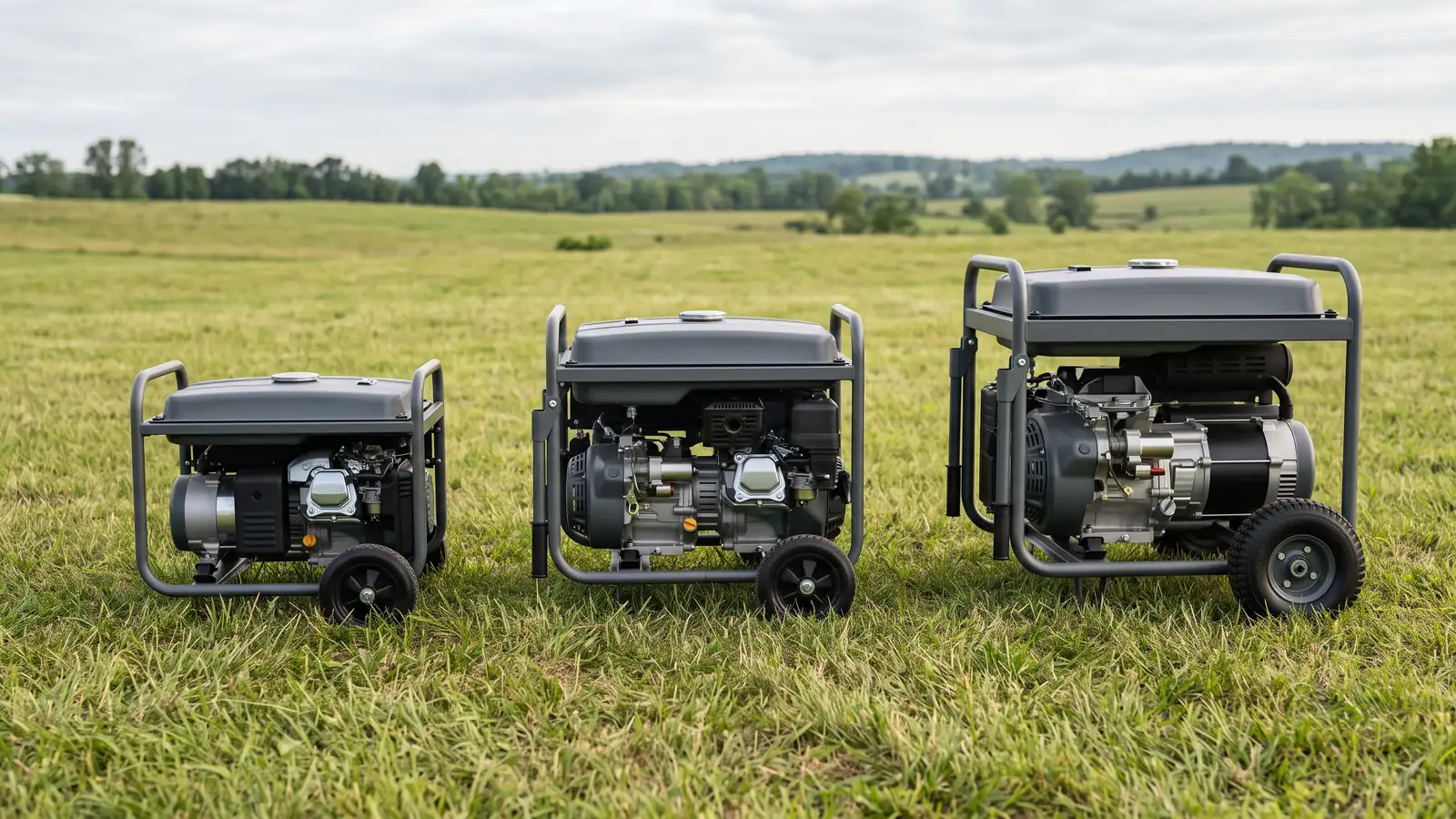
- Inverter (WEN 56250iX, iGen2550DFc, iGen4000DFc, DF480iX): quieter, lighter, cleaner power for electronics. Tops out around 4,000 to 5,000 W in a single unit.
- Open frame (WGen7500DFc, WGen9500DFc, XP13000EH): far more watts and 240 V outlets for house hookups and well pumps, but louder and heavier.
If quiet matters most, see the quiet generator guide. The full trade-off is in inverter vs conventional generators.
Step 3: gas or dual fuel?
Six of the seven run on gasoline or propane. Propane gives about 10% less power on most of them (the WGen7500DFc goes from 7,500 to 6,750 running watts) but it doesn't go stale in a sealed tank. Gasoline does: WEN's manuals say to use gas within 30 days. For a generator that sits waiting for a storm, that's a big deal. See the best dual fuel generators and dual fuel vs gas. To estimate how long your fuel lasts, use the fuel runtime calculator.
Step 4: connect it the safe way
To power your home's circuits, you need a transfer switch or an interlock kit, installed by a licensed electrician. Never plug a generator into a wall outlet. Backfeeding can kill utility workers and start a fire. See how to connect a generator to your house and interlock vs transfer switch. For an RV, see how to connect a generator to an RV; a 50 amp RV has its own generator picks.
Carbon monoxide: the non-negotiable
The CPSC is blunt: never run a generator inside a home, garage, basement, crawlspace or shed, even with doors and windows open. Run it outside, far from the house, with the exhaust pointed away from windows, doors and vents.
Consumer Reports says it only recommends portable generators with a CO safety shut-off, and suggests looking for an "ANSI/UL 2201" or "ANSI/PGMA G300" mark. Every pick here lists a CO shut-off. It's a backup, not permission: put battery CO alarms on every level of your home too. Read our generator carbon monoxide guide and how far a generator should be from the house.
Would a power station suit you better?
A battery power station makes no fumes and almost no noise, so it can sit indoors. For phones, a CPAP, a router and a fridge for a day, it's often the easier choice. It can't run central air for long or refill itself from a gas can. See the best portable power stations and power station vs generator.
Which one should you buy?
- Most homes, through a transfer switch or interlock: Westinghouse WGen7500DFc.
- Camping and a 30 amp RV with one AC: Westinghouse iGen4000DFc, or the WEN DF480iX for more outlets.
- Fridge, lights and chargers on extension cords, carried by one person: WEN 56250iX, or the iGen2550DFc for propane and an RV outlet.
- A big house with central air and a well pump: DuroMax XP13000EH, or the Westinghouse WGen9500DFc.
Check the WGen7500DFc on Amazon · Check the iGen4000DFc on Amazon · Check the WEN 56250iX on Amazon · Check the XP13000EH on Amazon · Check the WGen9500DFc on Amazon
FAQ
What is the best size portable generator for a house?
For most homes, about 7,500 running watts with a 120/240 V outlet. That covers the essentials plus a well pump, a window AC or a 2 to 3 ton central AC, as long as you start big motors one at a time. Homes with central air and a well pump may need 9,500 W or more. Run the size calculator to check yours.
Is an inverter generator better than a regular one?
For camping, RVs, quiet and electronics, yes. For home backup with 240 V loads, an open-frame generator gives far more watts per unit. See inverter vs conventional.
Do all new portable generators have a CO shut-off?
Not all. Many current models do, and every pick on this site lists one on the maker's page. Check the maker's spec page or the box for a CO shut-off and an ANSI/UL 2201 or ANSI/PGMA G300 mark. See what a generator CO sensor does.
Can a portable generator run central air?
A 2 to 3 ton central AC usually needs a 7,500 W class generator with 240 V and nothing else big starting at the same time. A soft start on the AC helps. See generators for central air.
Why don't you list prices or ratings?
Prices change daily and differ by retailer, so we link to the listing instead. We don't test units, so we don't give star ratings; we compare the makers' published specs and show the math.
What to look for
- A maker-stated carbon monoxide (CO) shut-off. We don't list gas generators without one
- Running watts for everything on at once, and starting watts for your biggest motor
- Inverter for camping, RVs and quiet; open frame for the most watts for home backup
- A 120/240 V outlet (L14-30R or 14-50R) if you'll connect to the house
- Dual fuel, so you can store propane instead of gasoline
Models to consider
Westinghouse WGen7500DFc
Dual-fuel generator
- Power:
- 7,500 running / 9,500 starting W
- Fuel:
- Gas or propane (6,750 W on propane)
- CO shut-off:
- Yes
- CARB (California):
- No

Amazon.com price: $949.00
as of Nov 27, 6:12 PM EST · Details
Product prices and availability are accurate as of the date/time indicated and are subject to change. Any price and availability information displayed on Amazon.com at the time of purchase will apply to the purchase of this product.
Westinghouse iGen4000DFc
Dual-fuel generator
- Power:
- 3,300 running / 4,000 starting W
- Fuel:
- Gas or propane (2,970 W on propane)
- CO shut-off:
- Yes
- CARB (California):
- No

Amazon.com price: $799.00
as of Nov 27, 6:12 PM EST · Details
Product prices and availability are accurate as of the date/time indicated and are subject to change. Any price and availability information displayed on Amazon.com at the time of purchase will apply to the purchase of this product.
WEN 56250iX
Inverter generator
- Power:
- 1,900 running / 2,500 starting W
- Fuel:
- Gasoline
- CO shut-off:
- Yes
- Noise:
- 65 dB (at 25% load; distance not stated)
- CARB (California):
- No

Amazon.com price: $371.38
as of Nov 27, 6:12 PM EST · Details
Product prices and availability are accurate as of the date/time indicated and are subject to change. Any price and availability information displayed on Amazon.com at the time of purchase will apply to the purchase of this product.
We don't test units ourselves; figures come from manufacturer spec sheets and the sources linked. How we research.
Sources
- Westinghouse WGen7500DFc spec page (7,500 running / 9,500 peak W on gas, 6,750 on propane, 6.6 gal, 11 h at 25%, L14-30R, CO sensor, CARB compliant: no)
- Westinghouse WGen9500DFc spec page (9,500 running / 12,500 peak W on gas, 8,500 on propane, 6.6 gal, 12 h at 25% and 8 h at 50%, L14-30R and 14-50R, CO sensor)
- DuroMax XP13000EH product page (10,500 running / 13,000 peak W on gas, 10,000 on propane, 8.3 gal, 17 h at 25% and 8 h at 50%, L14-30R and 14-50R, CO sensor shutdown)
- Westinghouse iGen4000DFc spec page (3,300 running / 4,000 peak W on gas, 2,970 on propane, 1.69 gal, 7 h at 25%, TT-30R, ≤3% THD, parallel, CO sensor, 62.8 lb)
- Westinghouse iGen2550DFc spec page (1,900 running / 2,550 peak W on gas, 1,700 on propane, 1.1 gal, 11 h at 25% and 7 h at 50%, TT-30R, CO sensor, 43.2 lb)
- WEN 56250iX product page (1,900 rated / 2,500 surge W, Watchdog CO shutdown sensor, 37.5 lb)
- WEN 56250iX manual, Aug 2026 (65 dBA at 25% load, 1 gal tank, 4.8 h at half load) (PDF)
- WEN DF480iX product page (4,000 running / 4,800 peak W, 3,600 on propane, TT-30R, Watchdog CO shutdown sensor)
- WEN DF480iX manual, Apr 2026 (1.9 gal, 7 h at half load on gas, 78.5 lb) (PDF)
- Champion Power Equipment: generator wattage chart (appliance running and starting watts)
- Consumer Reports: generator buying guide (only recommends portables with a CO safety shut-off; ANSI/UL 2201 and ANSI/PGMA G300 marks)
- CPSC: Generators and engine-driven tools (carbon monoxide safety)
- Wikipedia: NEMA connector (L14-30 and 14-50 ratings)